Image - 2026-09-28 01:59
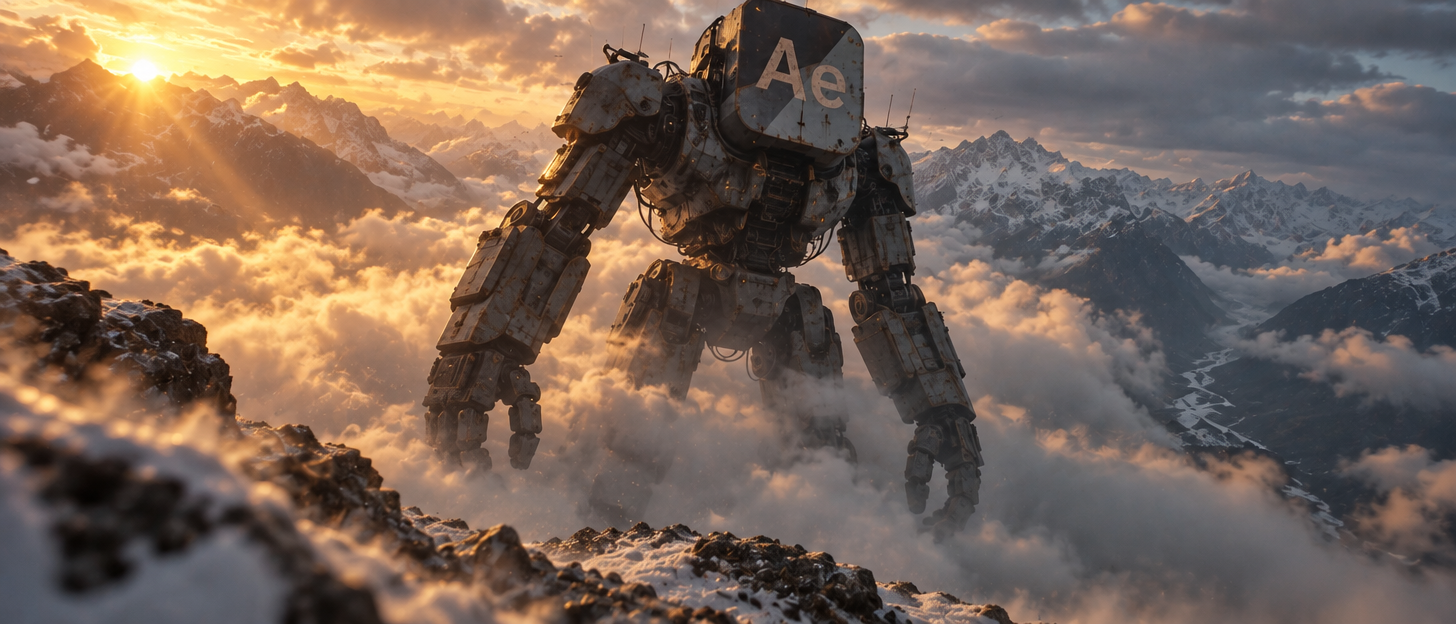
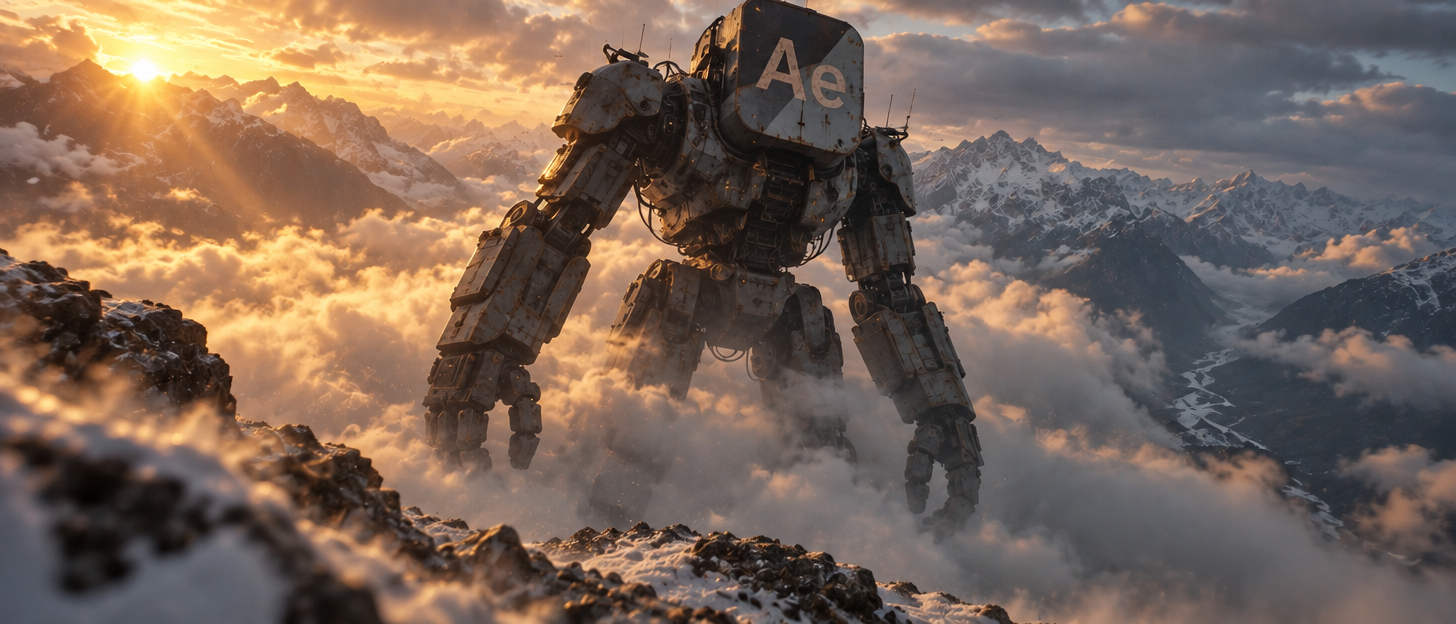
Use the attached reference as the ABSOLUTE reference for the robot’s appearance. Reproduce the robot 1:1 — same design, same proportions, same silhouette, same head, same “Ae” marking, same armor construction, same clawed hands and pillar legs. DO NOT redesign, stylize, simplify, or reinterpret the robot. === SCENE === Cinematic 21:9 photograph, captured on a real Arri Alexa LF with a 24mm cinema lens, T4, approximately 14 stops of dynamic range. NOT CGI. NOT a 3D render. NOT concept art. NOT illustration. This must look like a real large-format cinematic photograph. === CAMERA & COMPOSITION === The camera is positioned dramatically on the edge of a high rocky mountain cliff, looking DOWN and slightly ACROSS into an enormous alpine valley. Use a powerful wide-angle perspective that emphasizes extreme scale and vertical distance. The camera is relatively low compared with the titan’s upper body, creating a monumental sense of height, while still clearly looking down into the valley. ONLY A SMALL, CONTROLLED CAMERA TILT — a subtle Dutch angle, approximately 5–8 degrees. The frame is slightly destabilized, but NOT heavily rotated. The mountains and horizon remain readable. The titan is MUCH LARGER in the composition than before. The robot must dominate the entire middle of the frame, occupying approximately 65–75% of the vertical image height. It should feel so enormous that the surrounding mountains appear comparatively small. The titan is NOT a distant figure standing in the valley. It is a colossal structure rising through the entire mountain landscape, with its upper body towering dramatically above the surrounding terrain. === FOREGROUND === At the very edge of the cliff: Large rough rocks, snow, ice and small fragments of frozen terrain. These foreground elements are strongly out of focus and softly blurred, framing the lower corners of the image and creating powerful depth. A thin veil of mist passes close to the lens. Do not let the foreground obscure the titan. === TITAN — EXTREME SCALE === The colossal “Ae” titan stands in the valley below, enormously larger and closer than in the previous version. The robot must feel ABSURDLY MASSIVE through photographic scale cues. Its shoulders span a huge portion of the frame. Its head is large and clearly readable. Its upper torso rises dramatically above the surrounding cloud layer. The robot extends downward into the valley, but approximately HALF OF ITS BODY IS COMPLETELY HIDDEN INSIDE A MASSIVE CLOUD AND FOG LAYER. The clouds should physically wrap around the titan’s body. The lower torso, hips, upper legs and much of the legs disappear into dense alpine clouds. Only the upper body, shoulders, head and upper portions of the arms remain clearly visible above the clouds. The titan should look as though it is literally standing inside an enormous sea of clouds. The cloud layer must communicate depth and scale — clouds in front of the robot partially overlap its body, while other layers sit behind it. Do NOT make the titan look like it is floating. Its hidden lower body continues naturally downward into the valley behind the cloud layer. === ROBOT APPEARANCE — EXACT REFERENCE === Reproduce the attached robot reference 1:1: * same tall elongated brutish silhouette * same enormous proportions * same massive square head * same “Ae” marking embossed in clean white across the front * same diagonal division of the head: one half darker charcoal, one half lighter warm grey * same thin vertical antenna rods on top of the head * same huge shoulders * same long heavy arms extending downward * same enormous clawed hands * same thick square pillar legs * same flat claw-like feet * same weathered pink-grey steel armor * same panel geometry * same rivets * same chipped paint * same rust and corrosion * same exposed hydraulics * same cable harnesses * same access hatches * same small warm amber indicator lights * same hard-surface industrial construction Every visible panel, rivet, seam and mechanical component must remain faithful to the reference. DO NOT turn it into a different robot. === POSE === Preserve the robot’s established proportions and natural standing posture. ONE ARM is slightly raised and cocked backward, creating a subtle sense of motion and latent power. The pose must remain physically massive and believable. Do not make the pose exaggerated or superhero-like. === CLOUD SCALE === The cloud layer is a major compositional element. Dense white-grey alpine clouds surround the titan approximately halfway up its body. Clouds obscure roughly 40–50% of the titan’s lower body. The cloud bank must be thick enough that individual mechanical structures gradually disappear into it. Some clouds overlap the robot’s torso and arms in the foreground, creating convincing atmospheric depth. The titan should emerge from the clouds like an enormous industrial mountain. === BACKGROUND === Towering snow-covered alpine peaks extend across the horizon. Because of the titan’s enormous scale, the mountains should feel like a vast natural environment around a gigantic artificial being. Deep glacial valleys disappear into atmospheric haze. Multiple layers of distant mountains create strong depth. Low fog fills the valleys. === LIGHTING === Deep golden-hour sunset. The sun is low behind the mountain ridge on the LEFT side of the frame. Powerful golden sunlight cuts through the cloud layer. Strong volumetric god rays illuminate individual clouds and drifting snow particles. The sunlight catches the titan’s upper edges, shoulders, head and armor. The “Ae” marking remains clearly readable against the darker atmospheric background. Warm golden rim light outlines the robot while its shadow-facing surfaces remain cold blue-grey. The enormous cloud layer catches both warm sunlight and cold blue ambient light, reinforcing the sense of depth. Natural cinematic lens flare and subtle halation. No artificial-looking glow. === SCALE & ATMOSPHERE === The single most important visual impression is: **AN ENORMOUS INDUSTRIAL TITAN RISING THROUGH A MOUNTAIN-SIZED SEA OF CLOUDS.** The viewer must immediately understand that the robot is colossal. Use perspective, atmospheric haze, cloud overlap, mountain scale and foreground depth to communicate its gigantic physical dimensions. The titan should feel comparable to a mountain in scale. The surrounding alpine landscape must make the robot appear even larger. Do NOT make the robot small and distant. Do NOT leave large empty sky around it. Do NOT place the entire body clearly above the clouds. Approximately half of the titan must disappear into the cloud layer. === FINAL VISUAL TARGET === A dramatic 21:9 real cinematic photograph from a mountain cliff. The camera looks down into an immense alpine valley with a slight 5–8° Dutch tilt. A colossal “Ae” industrial titan dominates the composition, dramatically closer and substantially larger than before. Its upper body towers above a dense cloud layer while roughly half of its enormous body disappears completely into the clouds. Snow-covered mountains surround it, making the titan appear almost mountain-sized. Golden sunset rays explode through the clouds and illuminate its upper armor. The image feels monumental, physically photographed, atmospheric and emotionally overwhelming. REFERENCE ROBOT = EXACT ROBOT APPEARANCE. SCENE DESCRIPTION = EXACT CAMERA, SCALE, ENVIRONMENT AND ATMOSPHERE. DO NOT REDESIGN THE ROBOT. DO NOT MAKE THE ROBOT SMALL. DO NOT REMOVE THE CLOUD OBSCURATION. DO NOT USE A HEAVY DUTCH TILT. DO NOT MAKE IT LOOK CGI.
Free to start · Generate videos and images with AI in seconds
More from this creator


More Gpt Image 2.5 images
См. все →