Image - 2026-09-27 22:13
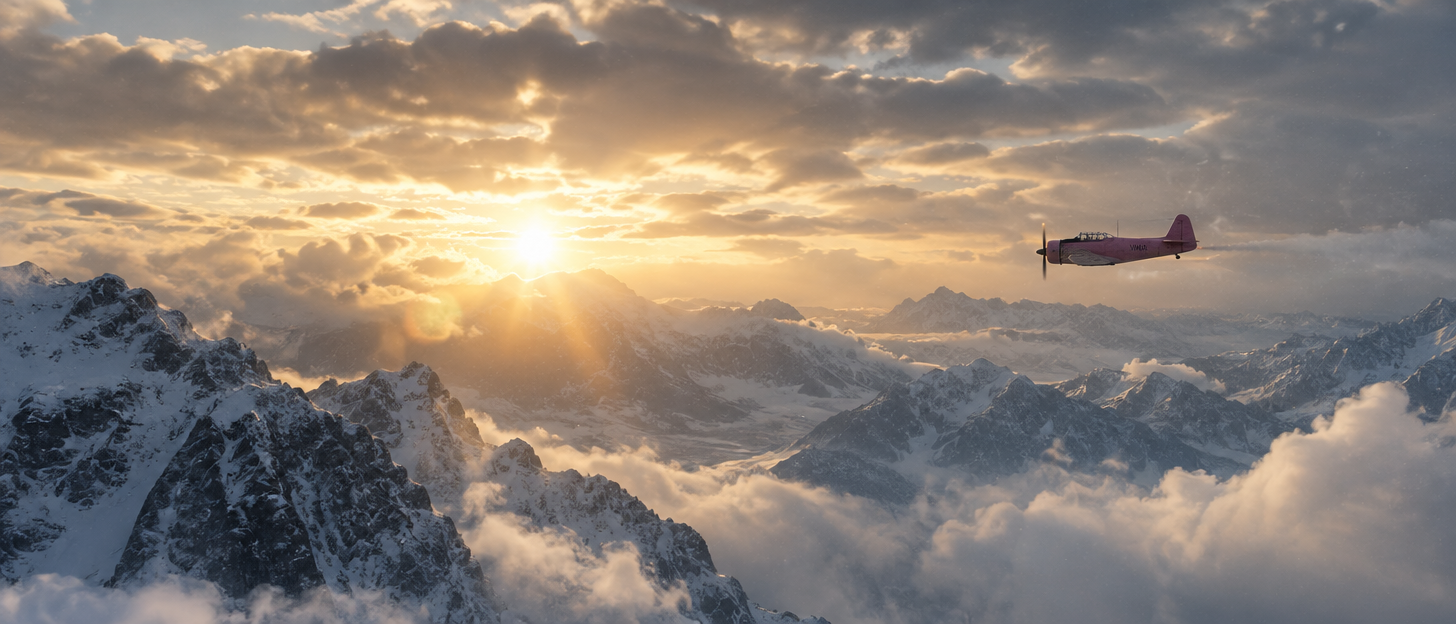
FINAL MASTER PROMPT — USE THE SUPPLIED AIRCRAFT REFERENCE AS THE ONLY AIRCRAFT REFERENCE Create a premium, photorealistic 21:9 widescreen cinematic aerial photograph. IMPORTANT: The supplied image reference is the AUTHORITATIVE AND EXACT REFERENCE FOR THE AIRCRAFT ONLY. The aircraft must be the SAME aircraft shown in the supplied reference image. Do not reinterpret it as a generic WWII aircraft. Do not substitute another aircraft. Do not redesign it. AIRCRAFT REFERENCE LOCK — ABSOLUTE PRIORITY: Reproduce the aircraft from the supplied reference with maximum visual fidelity. Preserve EXACTLY: - the aircraft's original silhouette - fuselage proportions - fuselage length and diameter - nose shape - engine cowling - propeller - propeller hub - cockpit and canopy geometry - canopy framing - wing shape and proportions - wing placement - tail shape - vertical stabilizer - horizontal stabilizers - control surfaces - visible panel construction - surface weathering - paint color - faded pink / dusty rose aircraft finish - all existing markings - the exact "VMA" marking visible on the reference - the exact placement, size and appearance of the "VMA" marking The aircraft MUST remain visibly PINK / FADED ROSE exactly as in the reference. The "VMA" marking MUST remain clearly visible on the aircraft. DO NOT replace the pink aircraft with a dark silhouette. DO NOT make the aircraft gray, black, green, brown or metallic. DO NOT remove the VMA marking. DO NOT invent a roundel or insignia that is not present on the supplied reference. DO NOT add military markings that are absent from the reference. DO NOT modify the aircraft's visual identity. The reference controls the aircraft. The environment is completely new. CAMERA AND COMPOSITION: Preserve the successful composition of the previous generation. Ultra-wide 21:9 cinematic frame. The aircraft remains relatively SMALL and FAR from the camera. Place the aircraft in the RIGHT THIRD of the composition. The aircraft flies clearly from RIGHT TO LEFT. Strict clean SIDE PROFILE. The camera is positioned approximately perpendicular to the aircraft's longitudinal axis. No three-quarter view. No front three-quarter view. No rear three-quarter view. No top-down angle. No dramatic banking. No visible exaggerated underside. No exaggerated perspective distortion. The aircraft should look naturally distant, flying through a gigantic alpine environment. The majority of the frame is the landscape, sky, clouds and atmosphere. Maintain generous negative space around the aircraft. The composition should feel like a frame from a very expensive aviation feature film, not like a product photograph of the aircraft. ENVIRONMENT: An enormous high-altitude winter alpine mountain range. Massive snow-covered mountains extending all the way toward the horizon. Deep valleys filled with clouds and atmospheric mist. Multiple layers of mountain ranges create enormous spatial depth. Large foreground mountain formations. Detailed middle-distance snowy peaks. Very distant mountains gradually disappearing into atmospheric haze. The mountains should feel cold, physically massive and geographically believable. Increase the amount of natural cloud cover compared with the previous image. Large, complex winter clouds should occupy significant portions of the frame. Clouds should partially obscure some mountains and reveal others. Natural cloud formations with realistic internal density and sunlight transmission. No fantasy clouds. No CGI-looking volumetric fog. WINTER WEATHER: The aircraft is passing through a light-to-moderate high-altitude winter snow squall. There should be visible atmospheric snow and fine ice crystals, but ONLY in controlled moderation. The aircraft is visibly penetrating a thin layer of snow and cloud. Use a small amount of naturally illuminated snow particles in the foreground and around the aircraft. Particles should be sparse, fine and realistic. They should appear as naturally occurring snow/ice crystals caught by the camera rather than artificial particle effects. IMPORTANT: Do NOT fill the frame with snow particles. Do NOT create a blizzard wall. Do NOT create hundreds of obvious white streaks. Do NOT obscure the aircraft. Do NOT make the weather look like a visual-effects simulation. The snow should simply communicate: cold, altitude, speed, and the aircraft cutting through winter atmosphere. AIRCRAFT / ATMOSPHERE INTERACTION: The aircraft should feel physically integrated into the atmosphere. Very subtle disturbed vapor and fine snow around the aircraft as it passes through the colder air. A faint, naturally dispersed wake behind the aircraft. The wake must be subtle and atmospheric, not a large contrail. Small snow particles can catch the sunlight near the aircraft. The aircraft should visually feel like it is actually moving through the air rather than being composited onto a mountain background. SUN: Keep the successful overall solar composition from the previous generation. Place the low winter sun close to the CENTER-LEFT region of the frame, slightly behind the aircraft. The sun is shining toward the camera through gaps between mountains and clouds. The aircraft is backlit. Create strong but physically realistic golden backlight. Sunlight should penetrate thin cloud layers and atmospheric snow. Visible but restrained volumetric sun rays through gaps in the clouds. The sun should feel powerful and dramatic. Use natural optical glare and restrained lens flare caused by the bright sun entering the cinema lens. The flare must remain subtle and photographic. No giant artificial lens flare. No colored CGI flare. No excessive bloom. No fantasy light effects. LIGHTING: Cold blue-gray winter shadows. Warm low-angle golden sunlight. Strong natural rim light around the aircraft silhouette. Subtle warm highlights on the upper surfaces of the aircraft. The aircraft remains darker than the sky because it is backlit, BUT the pink color and VMA marking must remain clearly readable. Do not turn the aircraft into a completely black silhouette. Preserve natural detail in the shadow side of the aircraft. The contrast should be cinematic and dramatic without crushing the blacks. AIRCRAFT ENGINE: Add a VERY SMALL, realistic warm engine exhaust/fire glow immediately behind the engine. It must look like a real piston-engine exhaust flare / hot exhaust rather than a jet flame. Very small. Localized. Subtle orange-yellow glow. A tiny amount of dark translucent exhaust smoke trails behind it and quickly disperses into the cold turbulent air. The smoke should be thin, irregular and physically believable. NO large flame. NO rocket exhaust. NO jet flame. NO giant smoke trail. NO fireball. The effect should only be noticeable when looking closely at the image. PHOTOGRAPHIC REALISM: This is NOT a render. It must look like a real photograph captured by an elite professional aerial cinematography team. Real camera. Real optical behavior. Real atmosphere. Real light. Real snow. Real clouds. Real mountains. Real aircraft. No CGI appearance. No 3D render appearance. No concept art. No digital illustration. No matte painting. No game-engine look. No AI-generated texture appearance. CAMERA: Large-format professional digital cinema camera. Large sensor with approximately 13–15 stops of usable dynamic range. 24mm full-frame-equivalent professional cinema prime lens. Wide environmental perspective without exaggerated distortion. Camera is positioned significantly far from the aircraft. Camera and aircraft are approximately at similar altitude. Camera is stabilized on a professional aerial cinematography platform. Smooth, stable cinematic framing. No drone-camera aesthetic. No fisheye distortion. No barrel distortion. No stretched aircraft geometry. Aperture approximately T4–T5.6. Shutter approximately 1/48–1/96 second. Low native ISO / clean exposure. Natural motion rendering. The propeller has realistic rotational motion blur. The aircraft itself remains naturally readable. DEPTH: Do NOT create artificial computational depth-of-field. The sense of depth should come primarily from: - enormous physical distance - atmospheric perspective - mountain haze - cloud layers - natural light scattering - scale Distant mountains progressively lose contrast and saturation naturally. Foreground mountains have more detailed texture. The aircraft remains naturally sharp enough to identify its exact shape and markings. COLOR: Premium cinematic color science. Natural winter whites. Natural snow color. Subtle warm golden sunlight. Cool atmospheric shadows. Restrained saturation. Rich but believable tonal separation. No aggressive teal-and-orange grade. No excessive orange. No crushed blacks. No HDR halos. No excessive clarity. No oversharpening. No fake film grain. No excessive grain. No plastic digital surfaces. OPTICAL CHARACTER: Natural large-format cinema-camera rendering. Smooth highlight rolloff. Subtle sensor texture. Natural micro-contrast. Realistic highlight bloom around the sun. Very subtle lens flare. Very subtle atmospheric veiling. Natural motion blur. Realistic exposure response. The image should feel expensive because of its photography, lighting and composition — NOT because of artificial effects. DRAMA: Increase the drama primarily through: - larger cloud formations - stronger sunlight - greater mountain scale - deeper atmospheric layers - subtle snow squall - powerful backlight - realistic atmospheric perspective - small engine exhaust glow - restrained optical flare Do NOT increase drama through excessive visual effects. The scene should feel epic, dangerous and cinematic while remaining completely believable as a real aerial photograph. FINAL VISUAL TARGET: A frame from an extremely expensive real-world aviation documentary / feature film shot on a large-format cinema camera in the Alps during a winter golden-hour snow squall. The aircraft is far away in the RIGHT THIRD, flying RIGHT TO LEFT in a strict side profile. The vast snowy mountains dominate the image. The sun burns through clouds near the center-left behind the aircraft. Clouds and fine snow partially cross the frame. A very subtle engine exhaust glow and thin smoke trail are visible behind the aircraft. The aircraft remains unmistakably the EXACT PINK AIRCRAFT FROM THE SUPPLIED REFERENCE with the EXACT VMA MARKING. Maximum realism. Maximum photographic credibility. Maximum cinematic scale. The image must look captured by a real camera, not generated. wrong aircraft, different aircraft, generic WWII fighter, aircraft redesign, aircraft reinterpretation, altered aircraft proportions, altered fuselage, altered nose, altered cockpit, altered canopy, altered wings, altered tail, different propeller, different engine, dark aircraft, black aircraft, gray aircraft, green aircraft, brown aircraft, metallic aircraft, missing pink color, missing VMA, altered VMA, incorrect VMA, extra VMA, invented markings, roundel, cockade, extra insignia, extra text, extra logos, extra symbols, three-quarter aircraft view, front three-quarter view, rear three-quarter view, top-down aircraft, aircraft banking, aircraft turning toward camera, aircraft flying left to right, aircraft centered, aircraft too large, aircraft too close, aircraft filling the frame, CGI, 3D render, Unreal Engine, Blender, game graphics, concept art, matte painting, illustration, plastic surfaces, synthetic textures, AI texture, overprocessed image, cheap render, stock image look, excessive HDR, excessive sharpening, oversharpening, clarity effect, fake detail, fake film grain, excessive snow, dense particles, particle storm, snow covering aircraft, white streaks everywhere, artificial particle effects, fantasy blizzard, CGI fog, artificial volumetric fog, giant fire, jet flame, rocket exhaust, fireball, large smoke trail, explosion, dramatic exhaust plume, giant lens flare, anamorphic flare streaks, colored CGI flare, excessive bloom, glowing mountains, glowing clouds, fantasy lighting, oversaturated orange, teal-orange grading, crushed blacks, clipped highlights, HDR halos, artificial depth of field, fake bokeh, fisheye, barrel distortion, wide-angle distortion, multiple aircraft, people, buildings, modern objects, UI, text overlays, watermark, logo, caption
Free to start · Generate videos and images with AI in seconds
More from this creator

More Gpt Image 2.5 images
См. все →