Image - 2026-10-01 18:01
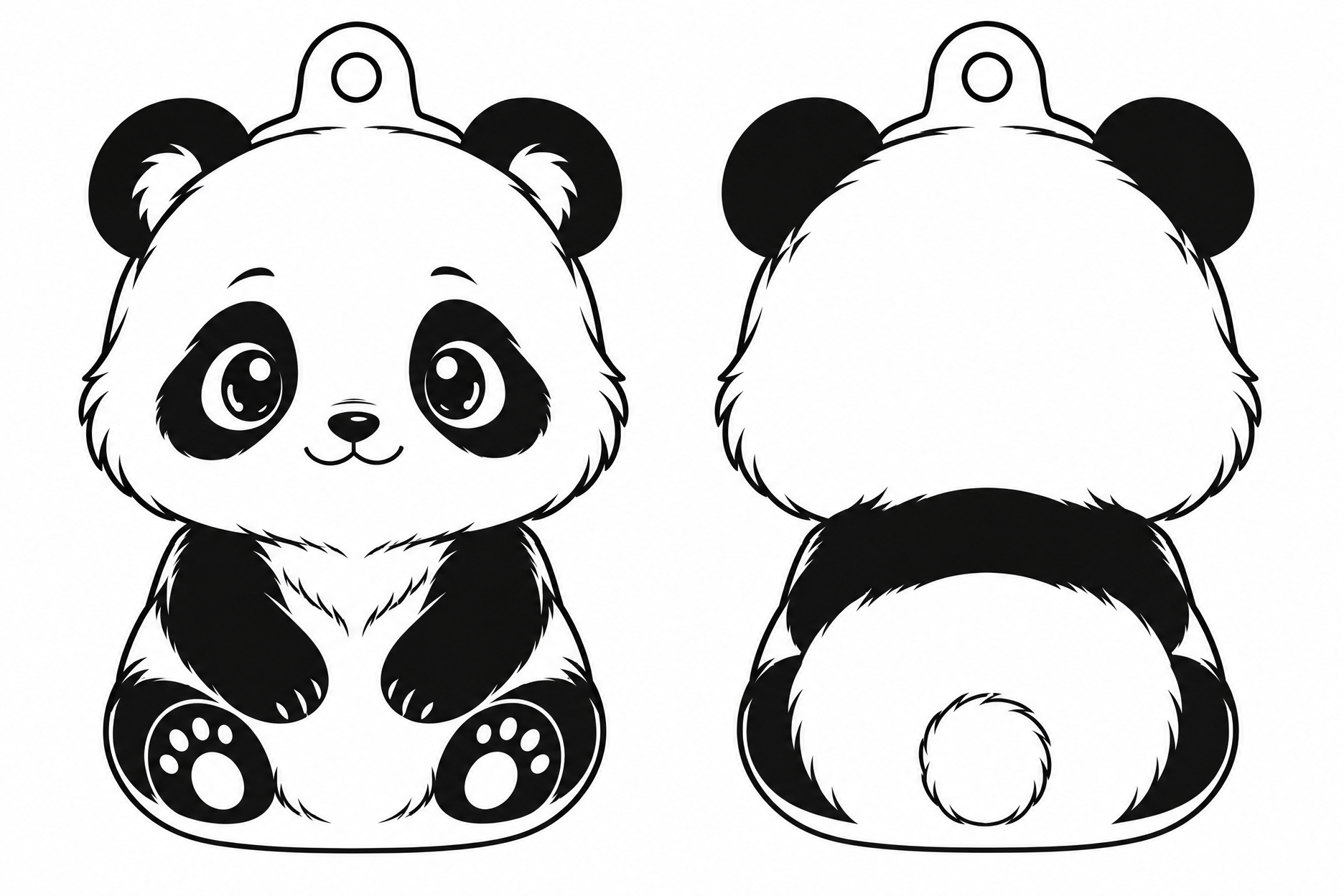
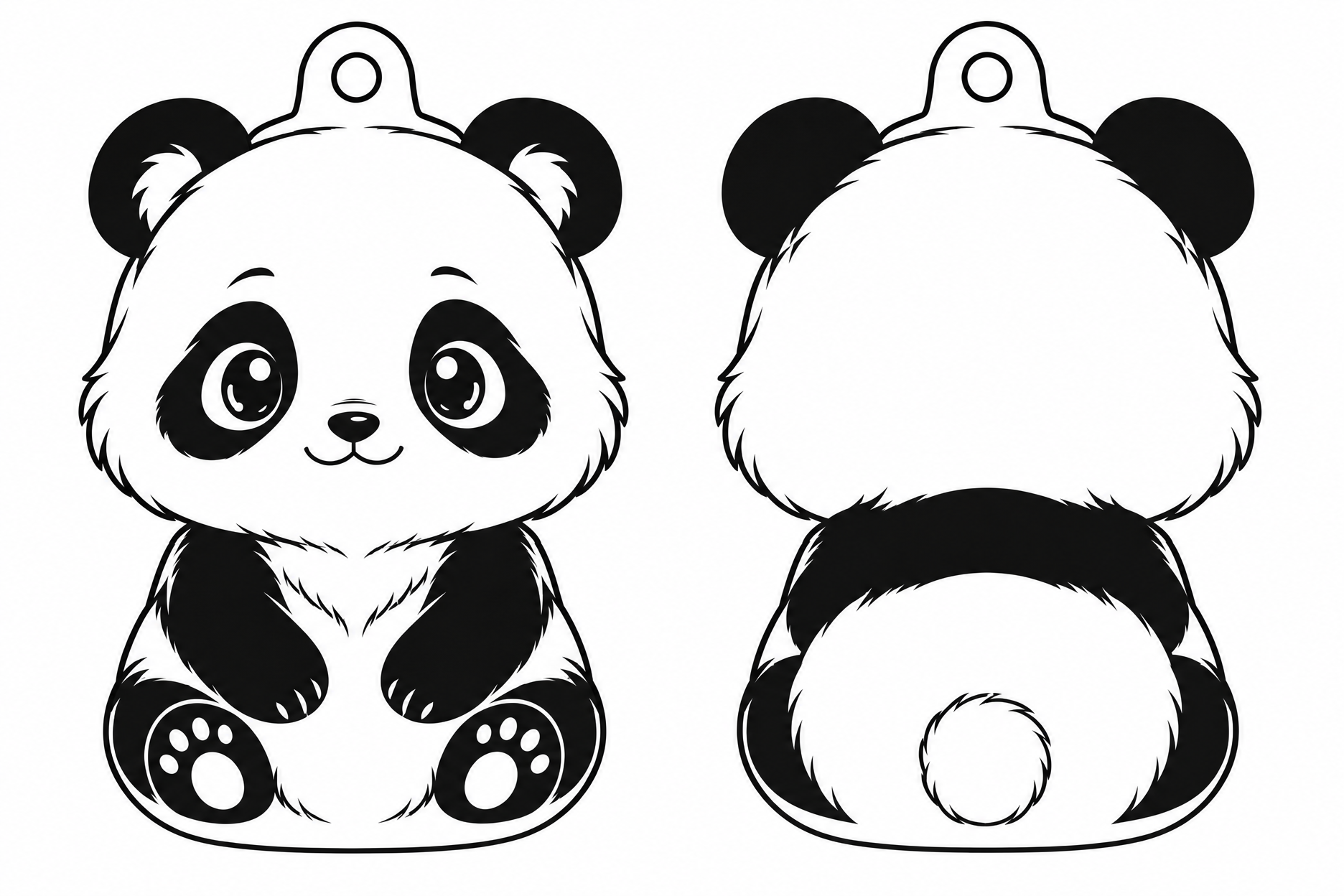
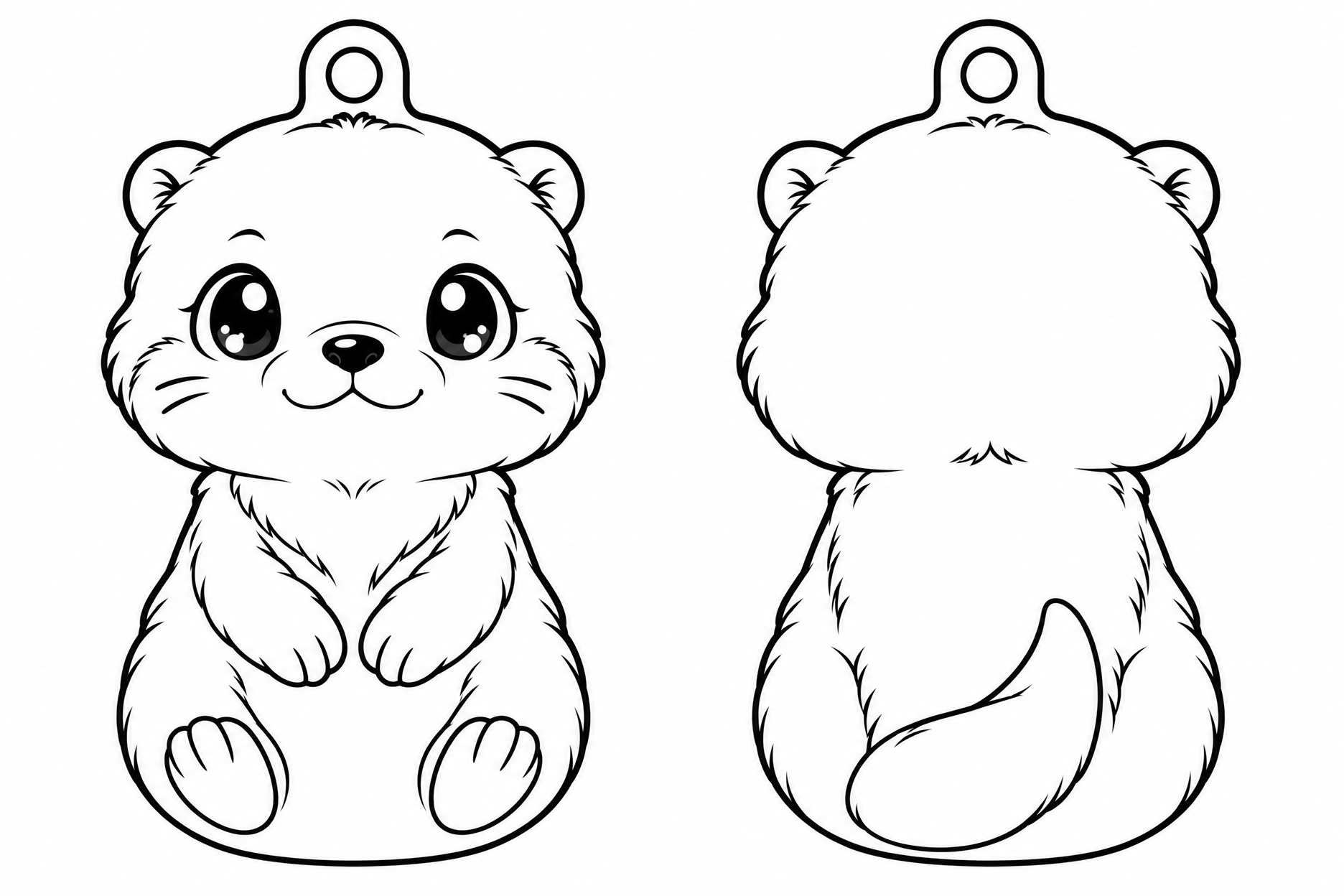
Create a premium black-and-white anime chibi PANDA KEYCHAIN DESIGN SHEET with matching FRONT and BACK engraving artwork. Landscape 3:2 canvas, highest available resolution. Exactly two designs side by side: FRONT on the left, BACK on the right. Pure white background. No text or labels. MANDATORY DESIGN SOLUTION Design ONE physical panda-shaped keychain with TWO different interior engraving illustrations. Construct one bilaterally symmetrical exterior template and duplicate it unchanged for both views. The exterior silhouette consists of: — two rounded ears with broad bases; — an oversized softly rounded head; — a compact, gently rounded body; — one broad, smooth lower edge; — a sturdy top-center attachment tab. Keep all paw details INSIDE the shared silhouette. Do not let front paws, rear feet, or the tail introduce different external contours. BOTTOM EDGE — CRITICAL Use ONE broad, smooth, shallow U-shaped bottom edge connecting the left and right sides of the body. No separate foot protrusions. No paired paw-shaped bumps. No central bottom notch. No tail protruding below the body. On the FRONT, draw the seated paws entirely inside this boundary. Leave a clearly visible white buffer between their lowest lines and the exterior bottom outline, approximately 5% of the total design height. On the BACK, show the rounded lower back and small tail entirely inside the SAME boundary. Repeat this exact uninterrupted U-shaped lower edge on both views. SHARED SHAPE AND ALIGNMENT Both designs must have identical: — ear shapes, positions, and spacing; — head width and cheek curves; — head-to-body transitions; — shoulder contours and body width; — lower edge; — overall scale, height, and width; — attachment tab and hanging-hole placement. Align both figures to the same baseline and vertical center. Leave comfortable white margins and a clear gap between the designs. If one figure were shifted horizontally over the other, the exterior contours and hanging holes should coincide. Do not draw two independent silhouettes. Change ONLY the interior artwork. CHARACTER DESIGN — PREMIUM ANIME CHIBI PANDA An irresistibly charming giant panda in animal form, not a humanoid. Use an oversized rounded head, small semicircular ears, plump cheeks, a tiny pear-shaped seated body, and short plush-looking paws. The head should occupy approximately half the character’s total height, excluding the attachment tab. Create a sophisticated collectible anime aesthetic: expressive, soft, beautifully proportioned, and delicately detailed without becoming cluttered. Use carefully grouped fur contours, restrained cheek tufts inside the outline, and elegant anatomical curves. No individual hair texture. FRONT — LEFT Show the panda seated directly facing the viewer, with its head level and its small front paws resting close to the belly. Create large, expressive anime eyes surrounded by characteristic panda eye patches. Shape the patches into soft, slightly tilted rounded forms that emphasize a sweet, gently curious expression. Keep the eyes clearly readable inside the black patches using generously sized white eye shapes and a few simple black iris details. Avoid tiny highlights and dense nested outlines. Add a small black nose, a delicate curved smile, a softly indicated muzzle, and subtle cheek curves without gray blush. Use rounded inner-ear shapes, a few organized chest-fur accents, and simple paw details. Keep the belly mostly white and open. Show simplified seated hind-paw shapes within the lower body, without letting them touch or alter the exterior bottom edge. Represent the panda’s black forelegs and shoulder markings with clean, controlled graphic shapes. Preserve clear white separation between overlapping limbs and the belly. BACK — RIGHT Show the SAME panda directly from behind in the SAME seated pose. Depict the back of the rounded head, rear surfaces of the ears, a gently curved nape, the characteristic dark shoulder band, a broad white lower back, and a small rounded panda tail. The tail must be drawn as an interior shape centered low on the back, entirely ABOVE the fixed bottom edge. It must not create a new external protrusion. Show only minimal rear-facing limb contours where needed. Keep the rear anatomy compact and consistent with the front pose. No eyes, eye patches, nose, mouth, muzzle, facial expression, belly details, front-facing paw pads, or front inner-ear shapes. Give the back the same degree of polish as the front through elegant fur groupings, balanced panda markings, and spacious negative areas. Do not add arbitrary decorative patterns. PANDA MARKINGS FOR ENGRAVING Preserve the panda’s recognizable black ears, black eye patches on the front, dark limbs, and dark shoulder band. Use purposeful solid-black shapes for these natural markings, while keeping the head, belly, and lower back predominantly white. Avoid merging adjacent black regions into unreadable masses. Use broad white separation channels or simplified white contour accents where necessary to distinguish limbs and overlapping forms. Do not fill the entire body with black. Do not substitute gray shading for black markings. KEYCHAIN ATTACHMENT Include one small, sturdy attachment tab at the top center of the head, positioned between the ears and smoothly connected through a broad rounded base. Place one circular hanging hole inside it. Leave a visibly substantial border of material around the hole. Repeat the tab and hole exactly on both views. No metal hardware, keyring, chain, clasp, or tassel. The hanging hole is the only intentional interior cutout. All other interior marks are engraving details. LASER-CUT CONSTRUCTION Keep the entire panda and attachment tab connected as one sturdy shape. Use broad ear bases and a broad head-to-body connection. Avoid thin necks, fragile bridges, sharp spikes, detached pieces, and floating decorations. No fur tufts extending beyond the fixed cutting outline. No offset decorative border or duplicate exterior contour. ENGRAVING LINEWORK Pure black marks on pure white. Smooth, crisp, polished anime linework with: — a strong, clean exterior contour; — medium-weight anatomical lines; — slightly lighter but still robust fur and expression details. No hairline strokes, microscopic patterns, tightly packed marks, or tiny isolated dots. Create richness through expressive shapes, selective fur details, beautiful proportions, and a controlled balance of black markings and white space. The design should remain readable and attractive when reduced to keychain size. STRICT EXCLUSIONS No color, gray fills, gradients, shading, cast shadows, lighting effects, halftones, hatching, stippling, realistic fur, sketch effects, or 3D rendering. No clothing, bamboo, food, bows, hearts, props, scenery, ground line, typography, labels, logos, or watermarks. No photograph, material simulation, engraved-object preview, wood grain, metal texture, or product mockup. FINAL VALIDATION Exactly TWO designs: FRONT left, BACK right. The same anime chibi panda in both views. One identical exterior template, including ears, body, bottom edge, attachment tab, and hanging hole. Front paws entirely INSIDE the cutting boundary. Rear tail entirely INSIDE the cutting boundary. Both bottoms use the SAME uninterrupted shallow U-shaped curve. Correct front and rear panda markings. Beautiful, detailed, high-contrast engraving artwork. If any anatomical detail conflicts with the shared outline, simplify or reposition the INTERIOR detail. NEVER change the exterior boundary.
Free to start · Generate videos and images with AI in seconds
More by SHPENDE
См. все →
More Gpt Image 2.5 images
См. все →